


UniCredit Bank Austria Sector Overview
Economic recovery continues, but geopolitical risks are dampening momentum
- The Austrian economy remained on a moderate growth trajectory in 2026 despite higher energy prices and geopolitical headwinds
- Manufacturing is increasingly becoming a pillar of the economy and is expected to grow by around one per cent in real terms in 2026
- The construction sector is showing initial signs of stabilisation, but remains in a difficult market phase
- The services sector continues to grow, but is being held back by high inflation, a strong propensity to save and geopolitical uncertainties
Despite the pressures caused by rising energy prices and the resulting increase in inflation, the moderate recovery of the Austrian economy has continued so far in 2026. In the first half of the year, economic output rose by 0.6 per cent in real terms compared with the previous year. Although economic momentum slowed in the second quarter, the Austrian economy remained robust overall.
Growth in the first half of the year was driven primarily by the manufacturing sector, which was able to continue its recovery. The services sector also remained on a growth trajectory, albeit at a slower pace than in 2025 as a whole. The construction sector, by contrast, continued to record declines, although the rate of decline slowed.
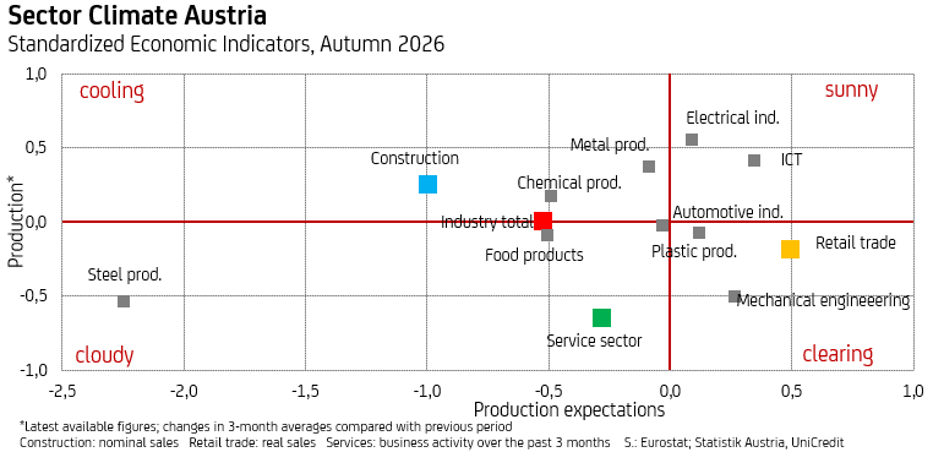
To calculate the sectoral climate indicator, trends in production and turnover up to the third quarter of 2026 are compared with the results of the business survey up to September 2026.
„Despite a challenging international environment, the Austrian economy has proved resilient so far in 2026. Industry in particular – led by the electrical industry, metal processing and the chemical production – has performed surprisingly well and is making a significant contribution to the ongoing economic recovery. However, geopolitical risks and higher energy prices are a serious drag on future development”, says Stefan Bruckbauer, Chief Economist at UniCredit Bank Austria.
Industry underpins the recovery
Despite high energy costs and ongoing supply chain problems, real industrial production rose by 0.6 per cent in the first eight months of 2026. Supported by a slightly more favourable export environment, sentiment in the sector has improved. In particular, metal processing, the electrical industry and parts of the consumer goods industry are showing an increasingly positive trend. Whilst the order situation is still assessed as weak, production expectations have improved noticeably.
“Austrian industry has proved surprisingly resilient in 2026. The recovery is likely to gradually spread to other sectors, although the pace is likely to remain limited due to geopolitical uncertainties and the continuing cost pressures”, says Pudschedl, adding: “The outlook for the electrical industry appears particularly favourable. Both the electronics and electrical engineering sectors are benefiting from structural growth trends such as digitalisation, automation and the energy transition. Metal goods manufacturing is also among the sectors with favourable prospects, whilst in mechanical engineering there are slowly increasing signs that the sector is bottoming out. However, a sustainable recovery will depend largely on stronger investment momentum in European sales markets.”
The outlook for the steel and chemical industries remains subdued. Both sectors continue to suffer from high energy and raw material costs, as well as a slow recovery in key customer industries.
Is the construction sector on the verge of a turnaround?
The Austrian construction industry continues to face a challenging environment. Following a decline in gross value added in 2025, it fell by a further 1.1 per cent in the first half of 2026. From January to August, construction output was around 2 per cent below the previous year’s level in real terms. Whilst building construction continued to record significant declines, civil engineering has remained relatively stable so far in 2026.
“There are increasing signs of stabilisation in the construction sector. Whilst civil engineering continues to benefit from public infrastructure projects, building construction is also likely to recover gradually in the course of 2027. However, due to persistently high construction costs and subdued demand, the recovery will be slow. Overall, the construction sector is expected to move from a phase of contraction to one of stagnation or slight growth in 2027”, predicts Pudschedl.
Services sector on course for stabilisation
Stabilisation in the services sector is continuing. However, household spending remains subdued due to geopolitical tensions and an increased propensity to save. At the same time, rising inflation is weighing on demand and investment. The information and communications technology sector, the property sector and parts of the financial sector continue to perform well. By contrast, numerous business-related services remain under pressure.
Demand expectations have improved since the summer and point to a slight upturn in business activity in the coming months. However, the momentum is likely to remain limited due to the prevailing uncertainties.
Retail sector suffers from inflation
So far in 2026, the retail sector has benefited from the gradual stabilisation of the economy. However, performance has varied considerably across the different segments. In the wholesale sector, nominal turnover rose by 2.8 per cent between January and July, but fell by 3.5 per cent in real terms. This suggests that the rise in turnover was primarily price-driven, whilst the actual volumes traded remained below the previous year’s level.
The recovery in the motor vehicle trade continued. Turnover rose by 4.5 per cent in nominal terms and by 3.6 per cent in real terms. Improved availability of vehicles led to stronger demand for both new and used cars.
The retail sector showed more subdued growth. Whilst consumer demand stabilised over the course of the year, households’ high propensity to save and the increased uncertainty caused by geopolitical tensions limited the momentum.
“The retail sector is in a transitional phase between stabilisation and recovery. Whilst the motor vehicle trade is benefiting from catch-up effects, developments in the wholesale and retail sectors remain subdued due to consumers and businesses continuing to act cautiously. However, with inflation easing, the economic conditions should improve in 2027”, said Pudschedl.
Upturn despite headwinds
“We expect the moderate economic recovery to continue over the coming quarters. Manufacturing remains a key driver of growth, whilst the construction sector is likely to gradually bottom out. In the services sector, a gradual improvement in demand should provide a slight boost to growth”, says Pudschedl, adding: “We forecast economic growth of 0.8 per cent for 2026, which should rise to 1.2 per cent in 2027. The greatest risks remain geopolitical tensions, the trend in energy prices and their impact on inflation and consumer behaviour.”
Further information can be found at: https://www.bankaustria.at/wirtschaft-oesterreich-branchenueberblick.jsp
Enquiries:
UniCredit Bank Austria Economics & Market Analysis Austria
Walter Pudschedl, Tel.: +43 (0) 5 05 05-41957;
Email: walter.pudschedl@unicreditgroup.at